Contact us
 Visit CPRE.org
 Donate
A Community Energy Vision for Crich, Fritchley and Whatstandwell
A Community Energy Vision for Crich, Fritchley and Whatstandwell ( Article by John Ydlibi October 2025)
The Campaign To Protect Rural England Derbyshire and Nottinghamshire (CPRE) have been promoting actions to address climate change with local communities and these actions start with ourselves. We recognise that achieving net zero emissions will need a large reduction in the use of fossil fuels going forwards and this will lead to a huge number of renewable energy developments, many of which will be situated in rural areas, and this raises the prospect of potentially widespread landscape impacts, as well as new income streams, arising from energy transition.
The economics of many renewable energy technologies and energy savings schemes are now very favourable , especially for community schemes where profits can be ploughed back to local people in either cheaper energy or wider community benefits.
We believe that for new renewables to be done well, local people must be involved in the decision making process to minimise the impacts of such developments on local landscapes and allow for a just transition to net zero.
This is why CPRE have developed the Community Energy Visioning (CEV) process to empower the people of Crich , Fritchley and Whatstandwell to set out where and under what circumstances they believe that new renewable energy could be sited in their local landscapes.
By developing this proactive vision for the future the residents of Crich, Fritchley and Whatstandwell are sending a clear message about the importance of their landscape and what renewables done well would look like locally.
The project was funded from a grant from Keele University ( Business School) £5k, CPRE Derbyshire £2k and Transition Crich £2k.
The process involves 3 workshops and about 25 residents attended each of the workshops. Dr Andy Tickle , an expert in this field , facilitated the workshops and also co-ordinated the final CEV Report.
The first workshop attendees discussed their connection with the Crich, Fritchley and Whatstandwell area, what areas in the landscape they particularly cherished and those places they felt less positively about. The discussions set the context for how the residents would react to potential changes to their landscape as a result of new renewable energy developments.
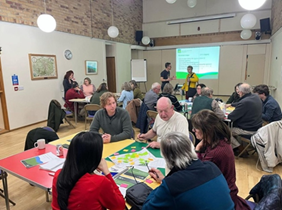
The second workshop focused on issues to do with energy infrastructure and how much energy and heat the residents of Crich, Fritchley and Whatstandwell need now and in the future. The discussions looked at what infrastructure they have now and how this would change with more new renewable energy structures. Using spreadsheet CESAR ( Community Energy Savings and Renewables) developed by the Centre for Sustainable Energy, attendees were able to explore how much renewable energy would need to be generated in the Crich area landscape to meet future needs and how the different types of technology could contribute to this.
For the third workshop we used maps of local landscapes to pinpoint locations where new renewables and related infrastructure could be sited. We also included discussions about who would own and profit from these renewable developments in the Crich countryside , and ways that the impact of these schemes on the landscape could be minimised and even deliver benefits to wildlife and nature. Working together attendees filled in maps of the Parish with where and how new renewable energy could be generated locally in the future, which forms the basis of this community vision.

We held an additional consultation meeting with the residents of Crich, Fritchley and Whatstandwell to present the draft vision and to identify next steps. The technology options were agreed and the likely locations for new generation were narrowed down, based on the community’s knowledge of their patch and the known planning constraints (e.g. .the World Heritage site) Next steps for promoting buy in to the project and involving wider stakeholders were discussed and agreed.
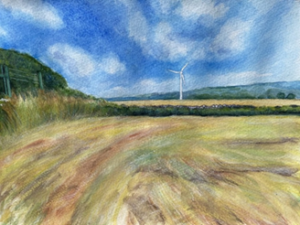
We commissioned a local artist Christine Gregory to produce 6 illustrations of renewable technology within the proposed landscapes so that the residents had a clearer view of the impact on their parish. These included a medium wind turbine West of Crich village , rooftop solar on Wakeridge Farm and Crich Junior School, ground mounted solar behind Chasecliff Farm and in Crich Cliff Quarry.

The vision was issued to Transition Crich and the residents of Crich , Fritchley and Whatstandwell in October 2025.

This vision marks the start of a conversation. The vision for renewable energy in the Crich area will no doubt adapt over time and as more stakeholders engage with the Project. Nevertheless , by setting out an initial plan for where, how and on what conditions more renewable energy could be generated in the parish, this community vision gives residents a powerful tool to take the future of their countryside into their own hands.
In summary this community vision shows that many residents in Crich , Fritchley and Whatstandwell are prepared to play a significant role in the effort to avert the climate emergency. This vision would generate enough low carbon energy to power all the needs of the Parish. Crich residents have shown that they are in favour of renewable energy not just in principle but would also support hosting new installations in their countryside as long as these developments are sited sensitively to protect the landscapes that they and visitors value. There is a clear appetite for renewable energy schemes that represent a suitable use of land , especially through the re-use of abandoned quarry sites.
CPRE Derbyshire and Nottinghamshire and Transition Crich will continue to support the residents of Crich, Fritchley and Whatstandwell as they take their community vision forward.